
For nearly 80 years, Tide has defined how Americans think about clean laundry. From powder detergent to liquid detergent and later Tide Pods, Procter & Gamble has repeatedly reinvented its flagship brand.

P&G is making a bold bet: Tide evo, a detergent “tile“—a flexible three-inch square made of detergent fibers that looks and feels more like a fabric pad than a traditional detergent.
The company spent more than a decade developing the product. Yet history suggests that technological innovation alone does not guarantee success. The ultimate question is whether Tide Tiles create enough customer value to justify adoption. To answer it, P&G must convincingly address three fundamental customer-value questions:
1. WHAT PERFORMANCE BENEFITS DOES IT PROVIDE?
P&G originally developed Tide Tiles because its scientists saw limitations in the Pod format.
Pods contain multiple chambers that activate when dissolved. However, adding additional performance features would require more chambers and larger pods.
Performance Features: The tile format potentially offers a new platform for delivering enhanced cleaning technologies. P&G’s researchers targeted specific consumer needs:
- Better odor removal from synthetic fabrics such as athleisure wear.
- Greater cleaning power for larger laundry loads.
- Improved performance in modern high-efficiency washers.
- Reduced product weight and packaging waste.
Performance Benefits: Customer benefits are not the same as product performance features. For customers, the key issue is not whether the technology is novel. The key issue is whether customers experience meaningful improvements in perceived performance.
- Remove odors better than Pods?
- Clean athletic clothing more effectively?
- Deliver superior stain removal?
- Reduce rewashing?
- Lower energy consumption by enabling effective washing in cold water?
2. HOW EASY IS IT TO USE?
Superior performance is meaningless if consumers find a product confusing or inconvenient. History shows that behavioral change is often the greatest barrier to adoption.

P&G spent years convincing consumers to switch from liquid detergent to Tide Pods. Tide Tiles require another behavior change – a new customer experience
Customers must create a new customer experience to understand:
- How many tiles to use.
- Whether the tiles dissolve reliably.
- How they work in different machine types.
- How they should be stored.
- Whether they are easier than Pods or liquid detergent.
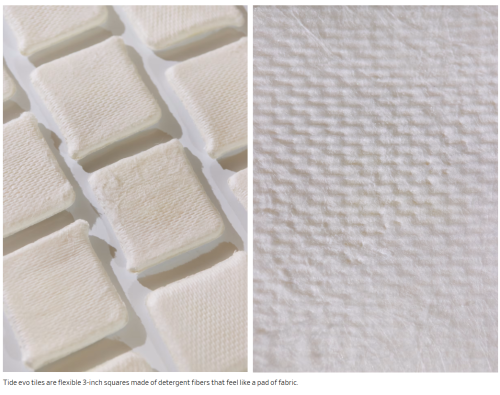
According to P&G, the product offers several potential usability advantages. The tiles are lightweight, easy to carry, and packaged in a compact paperboard box rather than a bulky plastic container. Consumers may appreciate reduced clutter and easier storage.
Still, do consumers actually perceive Tide Tiles as easier to use than existing alternatives? If customers need additional effort to learn or adapt, the product’s superior cleaning performance must more than compensate for that inconvenience.
3. WHAT IS THE RIGHT PRICE?
Perhaps the biggest challenge facing Tide Tiles is price. A box of Tide evo can potentially cost consumers nearly twice as much as a container of Tide Pods and substantially more than many liquid detergents. Competitors have expressed surprise not only at the product’s form factor but also at its premium pricing.
The challenge for P&G is straightforward: customers do not buy innovations—they buy value.
A higher price can be justified if customers perceive that the benefits improved performance and usability more than offset the additional cost represented with their premium price.
Consumers rarely evaluate detergent based on technology alone. They compare alternatives and ask a simple question: “What am I getting for the extra money?” A price that is too high may limit trial and adoption. A price that is too low may fail to capture the value created by the innovation. The optimal price depends not on what Tide Tiles cost to manufacture, but on the economic value customers believe they receive.
4. THE CUSTOMER VALUE TEST
With a price roughly twice that of competing products a positive customer value can only be achieved if the performance and use benefits are more than twice that of competitors. P&G can measure customer value in different ways outlined in MBM-7 and Customer Value Handbook.
- Positive Value where benefits (performance & use) exceed price.
- Fair Value where benefits (performance & use) equal price.
- Negative Value where benfits (performance & use) are lower than price.
Percieved customer value is a leading indicator of future sales and profits. If customers do not perceive a fair or superior value, sales and profits will not increase over time. If this is the case P&G will have to revisit their pricing and value proposition.
P&G has a long history of successfully disrupting itself. The company introduced Tide despite concerns that it would cannibalize its existing detergent brands. It later introduced Pods despite the success of liquid detergent. Tide Tiles represent the latest chapter in that tradition of growing market share, sales, and profits by maximizing customer value.

References:
Wall Street Journal (2026), “Tide Already Dominates Detergent. Why Is P&G Pushing a New Version?” by Natasha Khan, June 21 2026.